
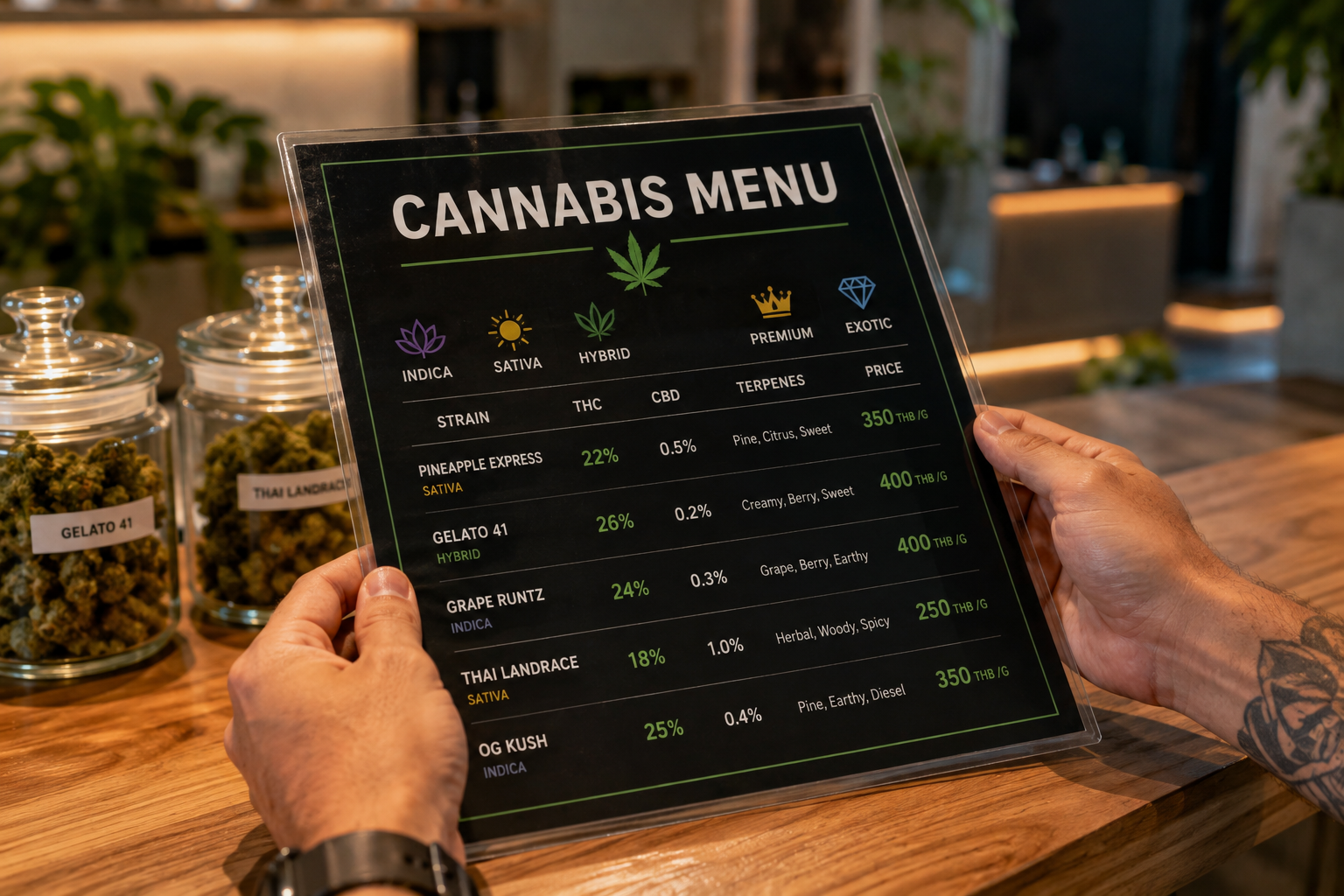
A Cannabis Menu Thailand visitors see in Bangkok, Pattaya or other tourist areas can look surprisingly complicated. One strain is labelled Indoor, another Greenhouse, another Exotic, and the next claims 28% THC. Prices may range dramatically even when two flowers look almost identical. For beginners, it is not always obvious which information actually matters and which words are mainly there to sell the product.
Thailand makes these distinctions especially important. The country’s tropical sunlight creates excellent growing opportunities, but high temperatures and humidity also make environmental control important. Meanwhile, modern Thai growers cultivate everything from traditional local genetics to American-style Hybrids under sophisticated indoor conditions. “Grown in Thailand” can therefore describe products at almost every quality level.
The easiest way to read a cannabis menu is to stop treating every label as a quality score. Indoor, Greenhouse and Outdoor describe cultivation methods. THC and CBD describe cannabinoids. Terpenes describe much of the flower’s aroma. Premium and Exotic are usually commercial categories rather than scientific standards. Once those differences are understood, comparing cannabis becomes considerably easier.
This guide explains what the most common terms on Thai cannabis menus actually mean, when paying more makes sense, and how WeedBKK uses menu information to help customers compare strains based on quality, preferences and budget rather than simply choosing the most expensive flower.
Contents:
- What Does a Cannabis Menu in Thailand Actually Tell You?
- Indoor vs Greenhouse vs Outdoor: What’s the Difference in Thailand?
- Do Premium and Exotic Actually Mean Better Weed?
- What Do THC % and CBD % Mean on a Thai Cannabis Menu?
- Why Should You Pay Attention to Terpenes?
- How Should You Compare Price, Sativa, Indica and Quality?
- How WeedBKK Makes Its Cannabis Menu Easier to Understand
What Does a Cannabis Menu in Thailand Actually Tell You?
A good cannabis menu should help you answer several different questions. What genetics does the strain have? How was it grown? How potent is it? What does it smell and taste like? What type of experience is it generally associated with? And finally, what are you paying for?
Thai dispensary menus commonly display Sativa, Indica or Hybrid alongside THC percentage and price. Better menus may also show CBD, cultivation method, flavour or terpene information and whether the flower belongs to a value, premium or exotic tier. The problem is that these categories describe completely different aspects of the product.
For example, “Indoor Hybrid, 24% THC, Exotic” contains three separate pieces of information. Indoor tells you about cultivation. Hybrid describes the genetics or general strain category. The THC number gives an indication of cannabinoid potency. Exotic is essentially the shop telling you where it believes that particular batch sits within its quality range.
Beginners often make the mistake of focusing on one number or word. They buy 30% THC because it sounds strongest, or automatically choose Indoor because it sounds premium. A better approach is to read the entire description and consider cultivation, genetics, freshness, aroma, cannabinoid strength and price together.
Indoor vs Greenhouse vs Outdoor: What’s the Difference in Thailand?
Indoor does not automatically mean better cannabis. It means the plant was cultivated inside a controlled environment where growers can manage lighting, temperature, humidity, airflow and irrigation much more precisely. That control is particularly valuable in Thailand, where outdoor humidity and tropical heat can make dense modern cannabis genetics challenging to grow consistently.
Good Thai indoor flower can therefore be exceptionally attractive: dense flowers, strong trichome coverage, carefully controlled moisture and consistent appearance from batch to batch. The disadvantage is cost. Lights, air conditioning, ventilation and dehumidification all require energy and equipment, which helps explain why quality indoor flower usually costs more to produce.
Greenhouse cannabis sits between indoor and outdoor cultivation. Growers can use Thailand’s abundant sunlight while maintaining some protection and environmental control. Modern greenhouses may also use supplemental lighting, ventilation and humidity management. Greenhouse should therefore not be interpreted as “almost outdoor.” A sophisticated greenhouse operation can produce extremely high-quality flower while keeping production costs below a fully controlled indoor facility.
Outdoor cannabis uses natural sunlight and is the most exposed to Thailand’s climate. Quality can vary substantially depending on genetics, season, cultivation and post-harvest handling. Outdoor flower is often less visually perfect than expensive indoor buds, but that does not automatically make it inferior. Research comparing genetically identical indoor and outdoor cannabis has found significant differences in both cannabinoid and terpene profiles, demonstrating that cultivation environment changes the finished product rather than simply creating a straightforward “good versus bad” hierarchy.
Do Premium and Exotic Actually Mean Better Weed?
“Premium” and “Exotic” are among the most misunderstood terms on a cannabis menu because there is no universal THC percentage or cultivation standard that automatically turns cannabis into an Exotic. Unlike Indoor or Greenhouse, these terms usually represent a shop’s own quality and pricing categories.
In Thailand, Exotic commonly describes flower positioned near the top of a dispensary’s menu. Buyers generally expect strong genetics, attractive buds, pronounced aroma, good trichome coverage, careful curing and an overall higher-quality smoking experience. Premium may occupy either the same category or one tier below it depending on the shop.
However, an Exotic label should never be interpreted as proof by itself. A beautifully grown 22% THC flower can deserve a premium position while an average 28% flower does not. Genetics, freshness, cultivation and curing matter. Cannabis also changes after harvest, meaning poorly stored premium flower can lose much of what originally justified its higher price.
This is particularly relevant when comparing Cheap Weed Thailand options with expensive strains. Some buyers genuinely benefit from paying for exceptional flower, while others mainly want a reliable product at a sensible price. The best value is not necessarily the cheapest gram or the most expensive Exotic, it is the quality level that matches what the customer actually values.
What Do THC % and CBD % Mean on a Thai Cannabis Menu?
THC percentage receives more attention than almost anything else on cannabis menus. For dried flower, the percentage is intended to indicate how much of the flower’s weight is represented by THC or its relevant cannabinoid measurement. In simple terms, a higher number generally indicates greater potential potency, but it should not be read as an exact prediction of how strong the experience will feel.
This distinction matters because customers frequently shop as if THC were a performance score. A 30% strain is not automatically “50% better” than a 20% strain. Individual tolerance, dose, genetics and the overall chemical profile all influence the experience. Laboratory results also describe a tested sample, so the number should be treated as useful information rather than a promise that every individual flower is chemically identical.
CBD is different. It is not intoxicating in the same way THC is, and CBD-forward cannabis occupies a separate part of the market. A flower containing considerable CBD and moderate THC may appeal to someone seeking a different cannabinoid balance from the THC-dominant strains that dominate many dispensary shelves.
For beginners, chasing maximum THC is rarely the smartest way to read a menu. A moderate product that suits your tolerance can be a better choice than the strongest flower available. WeedBKK can use THC and CBD figures as part of the recommendation rather than allowing a single percentage to make the entire decision.
Why Should You Pay Attention to Terpenes?
Terpenes are aromatic compounds found throughout the plant world, and they contribute heavily to the distinctive smell and flavour of cannabis. When one strain smells citrusy, another has a pine-like character and another is earthy, floral or unusually fruity, terpenes and other volatile compounds are major parts of that sensory difference.
Common cannabis terpenes include myrcene, limonene, pinene, caryophyllene and linalool. A menu may list several dominant terpenes or simply describe the flower as citrus, gas, fruit, pine, floral or earthy. For the average customer, those descriptions can actually be more immediately useful than memorising chemical names.
Terpenes are also why two flowers with the same THC percentage can feel like completely different products to a consumer. However, it is worth being careful with claims such as “this terpene will make you energetic” or “that terpene guarantees sleep.” Research continues into interactions between cannabinoids, terpenes and other cannabis compounds, but many strong claims surrounding the so-called entourage effect remain less certain than dispensary marketing sometimes suggests.
What terpenes can tell you very reliably is something about the flower’s aroma, flavour and freshness. If a strain is supposed to have a strong aromatic profile but smells almost like nothing, its impressive genetics and THC number become less interesting. For experienced buyers, aroma can therefore become one of the most useful pieces of information on the entire menu.
How Should You Compare Price, Sativa, Indica and Quality?
A cannabis menu becomes much easier to understand once price and strain type are treated separately. Sativa vs Indica tells you something about genetics and the traditional characteristics associated with a strain. Indoor vs Greenhouse vs Outdoor tells you how it was cultivated. Neither automatically determines how much it should cost.
A locally grown Thai Hybrid might offer better value than an expensive imported strain because there are fewer transport and supply-chain costs involved. Likewise, a good greenhouse crop may cost considerably less to produce than high-end indoor flower while still offering excellent aroma and cannabinoid levels. Paying less does not automatically mean buying bad cannabis.
This is why our Sativa vs Indica in Thailand guide is useful alongside a cannabis menu. Someone deciding between an uplifting Thai-grown Sativa, a balanced Hybrid and a heavier Indica-dominant option is answering a different question from someone deciding whether to spend more on Indoor or Exotic flower.
The same applies to Cheap Weed Thailand. Budget cannabis makes sense when the lower price comes from efficient local production, larger quantities or a less visually perfect batch. It becomes poor value when the savings come from weak aroma, bad storage, excessive age or inconsistent quality. A useful menu should help buyers distinguish affordable from simply cheap.
How WeedBKK Makes Its Cannabis Menu Easier to Understand
A cannabis menu should not require customers to become cultivators or chemists before they can make a sensible choice. WeedBKK uses familiar information such as Sativa, Indica, Hybrid, THC, CBD and quality tiers to make the first comparison easier, while still recognizing that those labels never tell the complete story.
If two products have similar THC numbers but very different prices, the explanation may be cultivation method, genetics, aroma, flower structure, freshness or overall batch quality. Likewise, someone asking for “the best” flower may actually be looking for the best flavour, strongest potency, smoothest quality or simply the best value. Those are four different requests.
This is where product knowledge becomes more valuable than a long menu. Beginners can describe their tolerance, preferred characteristics and budget rather than trying to interpret every percentage themselves. More experienced customers can compare Thai-grown Indoor, Greenhouse, Premium and Exotic selections using the characteristics they already know they prefer.
The easiest way to read a Cannabis Menu Thailand customers encounter is therefore to work from the important information outward: first choose the general Sativa, Indica or Hybrid direction, then consider THC/CBD strength, cultivation method and terpene profile, and finally decide how much the additional quality is worth to you. WeedBKK’s role is to make those differences clear so customers can choose based on the actual product rather than whichever strain has the highest percentage or most expensive label.