
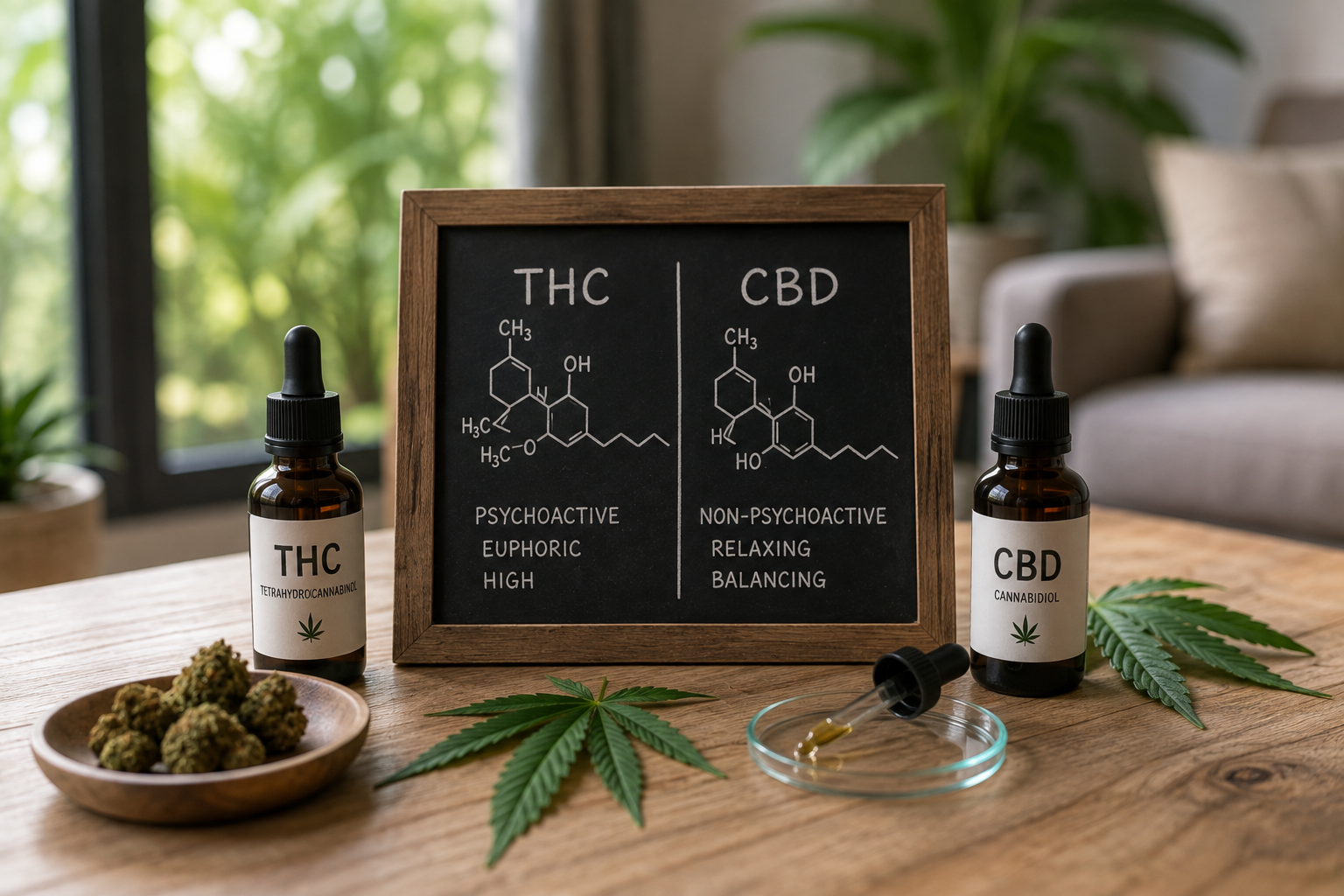
THC vs CBD in Thailand is one of the most useful things to understand before trying to make sense of a Thai cannabis menu. Tourists arriving in Bangkok or Pattaya may see flower advertised at 15%, 20%, 25% or even higher THC, while another product highlights CBD instead. For someone new to cannabis, those numbers can easily look like a simple strength rating, but they describe two cannabinoids with very different properties.
THC is primarily responsible for the intoxicating effects associated with cannabis. CBD does not create the same conventional cannabis high. Cannabis flower can be THC-dominant, CBD-dominant or contain a mixture of both, and the balance can matter just as much as whether the strain is labelled Sativa, Indica or Hybrid.
Thailand adds another layer because its market combines traditional Thai genetics, locally grown international strains and a wide range of modern Hybrids. A Thai-grown Sativa might contain considerably more THC than another Sativa beside it, while a Hybrid with a lower THC percentage could still be a better choice for a beginner. The highest number on the menu is not automatically the best product.
This guide explains THC and CBD from a practical Thailand perspective: what the percentages mean, how different strengths compare, how cannabinoids relate to Sativa, Indica and Hybrid strains, what beginners should consider, and what tourists and locals need to understand about Thailand’s current cannabis rules.
Contents:
- THC vs CBD in Thailand: What’s the Actual Difference?
- What Does THC Actually Do?
- What Does CBD Actually Do?
- What Do THC and CBD Percentages Mean on Thai Cannabis Menus?
- How Do THC and CBD Relate to Sativa, Indica and Hybrid?
- What Should Beginners and Tourists Choose in Thailand?
- How WeedBKK Helps Customers Understand THC, CBD and Strength
THC vs CBD in Thailand: What’s the Actual Difference?
THC and CBD are both cannabinoids naturally produced by cannabis, but they should not be treated as stronger and weaker versions of the same ingredient. THC, or tetrahydrocannabinol, is intoxicating. It is the cannabinoid most closely associated with feeling high and with changes in perception, coordination, attention and short-term memory.
CBD, or cannabidiol, does not produce the same intoxicating high. This is why CBD products exist as a separate category internationally and why some people specifically look for CBD-dominant cannabis rather than conventional high-THC flower. CBD can still affect the body and can interact with medications, so “non-intoxicating” should not be confused with completely inactive.
Most recreational-style flower seen on modern cannabis menus is THC-dominant. CBD levels are often comparatively low unless the cultivar has specifically been selected for CBD or a balanced THC-to-CBD ratio. Consequently, seeing “0.5% CBD” beside “22% THC” does not mean the product is approximately half THC and half CBD, it is overwhelmingly THC-dominant.
The important lesson for Thai buyers is that THC tells you something about potential potency, while CBD tells you something different about the cannabinoid balance. Neither number tells you everything about quality. Genetics, cultivation, freshness, terpenes, dose and individual tolerance still matter.
What Does THC Actually Do?
THC is the number most customers notice first because it is the primary intoxicating component of cannabis. Higher THC generally means greater potential potency, but the relationship is not perfectly linear. A flower labelled 30% THC should not be interpreted as automatically providing an experience that is 50% better, or even exactly 50% stronger than a 20% flower.
Individual tolerance changes the equation considerably. Someone accustomed to strong cannabis may find a moderate-THC strain relatively easy to manage, while the same flower can feel intense to a first-time or occasional user. The amount consumed also matters. A smaller amount of stronger flower can expose someone to less total THC than a much larger amount of moderately potent flower.
High THC is therefore best understood as a characteristic rather than a quality score. Premium flower does not need to have the highest THC percentage on the shelf. A well-grown 20% strain with excellent freshness, aroma and genetics can be a considerably more desirable product than mediocre flower marketed at 28% simply because the larger number attracts attention.
This distinction is particularly useful in Thailand, where cannabis menus can contain inexpensive local strains beside premium Thai indoor and international genetics. Customers comparing prices should ask what they are actually paying for rather than assuming that every additional percentage point of THC automatically increases quality.
What Does CBD Actually Do?
CBD has become internationally famous largely because it does not produce THC’s conventional intoxicating effects. That makes CBD-dominant products fundamentally different from the high-THC flower many people associate with a dispensary. However, CBD is often surrounded by exaggerated wellness claims, so buyers should separate established cannabinoid differences from marketing promises.
CBD is pharmacologically active and has been studied for a wide range of potential medical applications. That does not mean every CBD oil, flower or consumer product should be expected to treat a medical condition. Product concentration, formulation, dose and evidence for a particular use all matter, and CBD can interact with some medicines.
Another common misconception is that CBD simply “cancels out” THC. The interaction between the two is more complicated and can depend on the dose and route of administration. Research involving orally consumed THC and CBD has even found circumstances in which high-dose CBD increased THC exposure rather than simply reducing its effects.
For someone reading a Thai cannabis menu, the practical distinction is easier: THC-dominant flower is chosen when THC is the main cannabinoid being sought, CBD-dominant products emphasize a non-intoxicating cannabinoid profile, and balanced products sit somewhere between the two. Customers should not assume the word CBD automatically means weak, medicinal or risk-free.
What Do THC and CBD Percentages Mean on Thai Cannabis Menus?
A percentage on dried cannabis flower represents cannabinoid content by weight. A flower labelled around 20% THC is therefore substantially THC-dominant compared with one containing only trace percentages. The number is useful for comparing products, but it should be treated as laboratory information rather than a guaranteed prediction of exactly how someone will feel.
For beginners, a rough practical way of reading THC-dominant flower is to think in broad ranges rather than obsessing over individual percentage points. Flower below roughly 15% THC is relatively lower-strength by today’s commercial standards; around 15–20% is moderate; 20–25% is strong; and products above roughly 25% should generally be regarded as high-potency flower. These are useful shopping categories, not official scientific definitions.
That distinction matters because modern Thai menus can contain surprisingly strong flower. A tourist who occasionally used mild cannabis years ago may underestimate a modern indoor Hybrid simply because it looks like ordinary dried flower. Conversely, an experienced consumer may deliberately prefer a moderate strain because they value its genetics, flavour or overall profile more than maximum potency.
CBD percentages should be read in the same literal way, but the comparison is different. A flower with substantial CBD and relatively little THC represents a fundamentally different cannabinoid balance from a typical 20–25% THC strain. When both percentages are listed, reading them together gives substantially more information than looking at THC alone.
How Do THC and CBD Relate to Sativa, Indica and Hybrid?
Sativa does not mean high THC, and Indica does not mean high CBD. This is one of the most important misconceptions for beginners to remove. Sativa, Indica and Hybrid are strain or genetic categories commonly used to describe cannabis, whereas THC and CBD are chemical compounds measured within the plant.
A Sativa can contain 15% THC or more than 25%. An Indica can do the same. A Hybrid can be relatively moderate or extremely potent. Likewise, CBD-dominant cultivars can have different genetic backgrounds. The familiar Sativa-versus-Indica distinction therefore cannot replace the cannabinoid numbers on a menu.
This is particularly relevant with Thai-grown cannabis. Traditional Thai genetics are strongly associated with narrow-leaf Sativa-type plants, but modern cultivation in Thailand includes international Sativa, Indica and Hybrid genetics grown locally. “Thai-grown,” “Sativa” and “22% THC” are three different pieces of information describing three different characteristics of the same flower.
A sensible buying process is therefore to decide what general strain profile you prefer, then look at potency. Someone wanting a daytime-oriented option may begin with a Sativa or Sativa-dominant Hybrid and then compare THC levels. Someone looking toward an Indica-dominant evening option should do the same. Our Sativa vs Indica in Thailand guide goes deeper into how those categories work specifically with Thai-grown cannabis.
What Should Beginners and Tourists Choose in Thailand?
The biggest beginner mistake is surprisingly simple: choosing the strongest product because it appears to offer the best value. If two strains cost similar amounts and one says 18% THC while another says 28%, the stronger one can look like the obvious bargain. For someone without established tolerance, however, more THC may simply make the experience harder to control.
Beginners are generally better served by starting conservatively and learning their own response before moving toward high-potency products. A moderate-strength Hybrid can often be easier to understand than choosing an extreme simply because it is labelled Sativa, Indica or Exotic. People vary considerably, so there is no single THC percentage that is universally “beginner strength.”
Tourists should be especially careful about comparing Thailand with cannabis experiences elsewhere. Modern Thai indoor cultivation can produce highly potent flower, and a familiar strain name does not guarantee that a particular batch will have the same potency as one previously encountered in Europe, North America or another country. Check the actual menu information rather than relying solely on the name.
Visitors also need to understand that Thailand’s cannabis framework changed substantially. Cannabis flower is currently regulated as a controlled herb and access is restricted to medical purposes under the applicable Thai rules. A valid prescription from an authorized practitioner is required for cannabis flower, with dispensing limited to medically necessary quantities of no more than a 30-day supply. Tourists should not interpret the visibility of cannabis businesses as meaning unrestricted recreational use is legal.
How WeedBKK Helps Customers Understand THC, CBD and Strength
A useful cannabis menu should make THC and CBD easier to understand instead of turning percentages into a competition. WeedBKK organizes products so customers can compare important characteristics such as cannabinoid strength, Sativa, Indica or Hybrid classification and different quality levels rather than having to choose from strain names alone.
This matters because two customers asking for “good weed” may be describing completely different things. One may want moderate THC and a balanced profile. Another may already have substantial experience and specifically prefer stronger flower. Someone else may be interested in CBD rather than intoxication. The correct recommendation depends on the person and the intended medical context, not simply whichever strain has the highest THC number.
Price also needs context. As explained in our Cheap Weed Thailand guide, lower-priced flower is not automatically poor quality and premium flower is not automatically stronger. Local production, indoor versus greenhouse cultivation, genetics, appearance, aroma and batch quality can all affect price independently of THC percentage.
Ultimately, the simplest way to understand THC vs CBD in Thailand is to stop looking for one universally better cannabinoid or one perfect percentage. THC describes intoxicating potency, CBD represents a different cannabinoid profile, and Sativa, Indica and Hybrid add another layer of information. WeedBKK helps customers read those factors together so the choice can be based on suitable strength, quality and individual requirements rather than marketing numbers alone.