
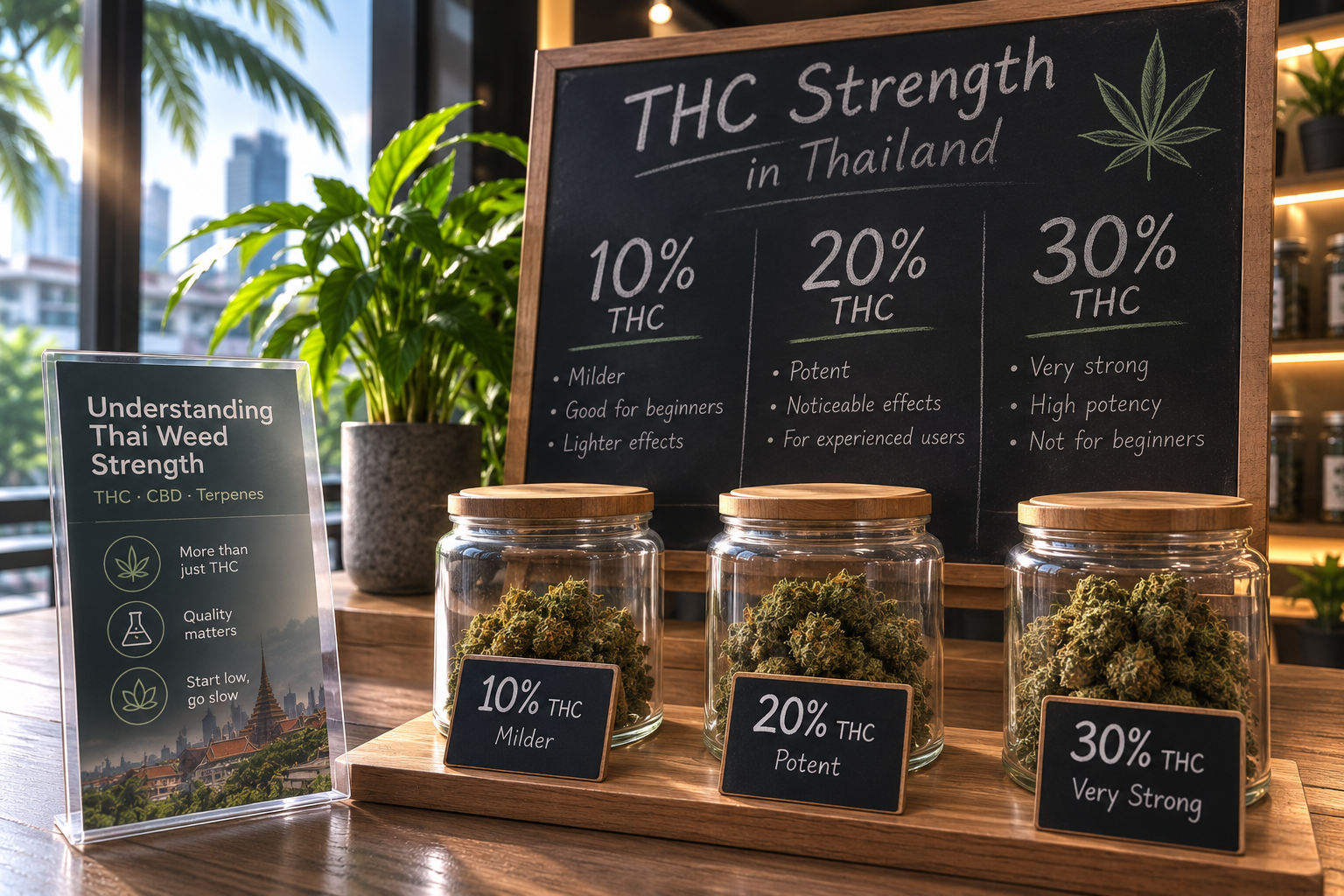
Thai Weed Strength can vary dramatically, from relatively mild flower around 10% THC to products advertised at 20%, 25%, or even 30% THC and above. For tourists and first time buyers in Thailand, those percentages can make choosing cannabis unnecessarily confusing. Is 30% automatically better than 20%? Will 10% be too weak? And can you actually trust the THC number printed on every dispensary menu?
The short answer is that THC percentage matters, but it does not tell you everything about cannabis strength or quality. Terpenes, CBD, individual tolerance, freshness, dosage, genetics, and storage conditions all influence the experience. Two strains with the same THC level can feel noticeably different.
This guide explains how Thai weed strength works, what 10%, 20%, and 30% THC actually mean, why beginners should not automatically choose the highest number, and how to compare cannabis more intelligently. WeedBKK provides THC and CBD information where available to help customers understand what they are looking at rather than focusing only on the highest number.
Important: Thailand’s cannabis market is currently medical focused. Cannabis flower is a controlled herb, and visitors should follow current Thai medical and prescription requirements. Strength information should be used to understand products, not to encourage stronger or recreational use.
Contents
- Thai Weed Strength: How Strong Is Cannabis in Thailand?
- What Does 10% THC Weed Feel Like Compared With Stronger Cannabis?
- Is 20% THC Considered Strong Weed?
- Is 30% THC Weed Really Better?
- Why Do Terpenes Matter Alongside THC?
- Can You Trust THC Percentages on Thai Cannabis Menus?
- What Cannabis Strength Should a Beginner Choose in Thailand?
Thai Weed Strength: How Strong Is Cannabis in Thailand?
Cannabis in Thailand comes in a wide range of strengths. Traditional Thai cannabis was generally milder than modern high THC indoor strains found in international markets. Today, Thai dispensaries may offer local genetics alongside greenhouse and indoor flower bred for higher potency.
As a result, customers may see products listed at 10 to 15% THC, 20 to 25%, and sometimes even around 30%. This can make it seem like higher numbers always mean better cannabis, but the reality is more complex.
THC, or tetrahydrocannabinol, is the main intoxicating compound in cannabis. Higher THC usually means more potency per gram, but the overall experience does not scale in a simple or predictable way.
A 30% product is not simply three times stronger than a 10% product in terms of experience. For many users, especially those with low tolerance, moderate strength flower can actually feel more comfortable and easier to manage.
Key point: Thai weed ranges from mild to very strong, but THC percentage is only one part of the picture.
What Does 10% THC Weed Feel Like Compared With Stronger Cannabis?
Cannabis around 10% THC is generally considered mild by modern standards. However, it can still produce noticeable effects, especially for people with little or no tolerance.
Lower THC products can be useful in situations where controlled or lighter effects are preferred. In some medical contexts, a lower concentration may help users manage intake more precisely.
It is also important not to confuse potency with quality. A 10 to 15% strain can still be well grown, fresh, aromatic, and properly cured. Likewise, a poorly stored product does not become premium simply because it is labeled with a higher THC number.
This is especially relevant in Thailand, where outdoor and greenhouse flower may be more affordable but still offer good value depending on the user’s needs.
Key point: 10% THC is mild compared to stronger flower, but mild does not mean low quality.
Is 20% THC Considered Strong Weed?
Cannabis around 20% THC is generally considered strong, particularly for inexperienced users. However, modern menus often list higher numbers, which can make 20% seem average when it is not.
For people without tolerance, 20% THC can already produce significant effects. Increasing from 20% to 30% does not necessarily improve the experience and may increase the chance of unwanted effects such as anxiety, dizziness, or discomfort.
This is why beginners should avoid the idea that stronger is always better. Cannabis is not a product where maximum specification automatically equals a better result.
At this level, other factors become more important when comparing products, including CBD content, terpene profile, freshness, and cultivation method. These can explain why two strains with similar THC levels feel different.
Key point: 20% THC is already strong for many users, and higher numbers are not automatically better.
Is 30% THC Weed Really Better?
Thirty percent THC looks impressive and is often used as a marketing point. However, 30% THC does not automatically mean better cannabis.
High potency flower may be appropriate in specific medical situations under professional guidance, but it also delivers a much higher dose of THC per amount consumed. For inexperienced users, this can make effects harder to control.
There is also variation in testing methods and lab results. THC percentages can differ depending on sampling, batch differences, and testing standards. For this reason, THC numbers should be treated as estimates rather than exact guarantees of experience.
Customers should be cautious when every product on a menu claims extremely high THC levels. If multiple unrelated strains all show similar high percentages, it is reasonable to ask how those figures were measured.
Key point: 30% THC may indicate strong flower, but it is not a quality rating and should not be the only reason to choose a product.
Why Do Terpenes Matter Alongside THC?
Terpenes are natural aromatic compounds found in cannabis and many other plants. They are responsible for the citrus, pine, floral, herbal, and earthy scents associated with different strains.
Common cannabis terpenes include myrcene, limonene, pinene, linalool, and caryophyllene.
Terpenes help explain why two strains with similar THC levels can feel different in aroma, taste, and overall experience. Cannabis effects are influenced by a combination of cannabinoids, terpenes, dosage, and individual response.
For buyers, this means THC should not be the only factor when choosing a product. A fresh, aromatic 18% strain can be more enjoyable than poorly stored flower claiming 28% THC.
Many experienced users eventually focus less on THC numbers and more on genetics, freshness, aroma, and cultivation quality.
For more context on cannabinoids, see THC vs CBD in Thailand.
Key point: THC describes potency, while terpenes and overall quality describe the character of the cannabis.
Can You Trust THC Percentages on Thai Cannabis Menus?
THC percentages can be useful when they come from reliable testing, but not every listed number should be treated as exact.
Thailand’s cannabis market includes a mix of professionally tested products and flower with limited or inconsistent documentation. Even with proper testing, natural variation between plants and batches is normal.
Storage conditions and age can also affect how cannabis performs after testing.
A key warning sign is a seller who only relies on numbers without being able to explain the product. If a strain is advertised with unusually high THC, asking for testing information is reasonable.
Misleading marketing can also appear in potency claims. Terms like “premium 30% Cali” are sometimes used to justify higher prices without clear evidence. More examples of this can be found in Weed Scams Thailand.
Key point: THC percentages are useful for comparison, but they are not absolute proof of quality or guaranteed effects.
What Cannabis Strength Should a Beginner Choose in Thailand?
Beginners should not focus on finding the strongest cannabis available. A better approach is to choose a strength that matches personal tolerance and intended use.
People with no cannabis experience can be sensitive to THC, and even moderate products may feel strong. Starting too high increases the chance of an uncomfortable experience without added benefit.
It is also important to consider more than THC. CBD content, freshness, cultivation quality, and terpene profile all contribute to the overall experience. WeedBKK provides THC and CBD information where available to help customers make informed choices rather than defaulting to the strongest option.
If you are new to cannabis in Thailand, it is helpful to understand the basics before choosing a product. See Sativa vs Indica vs Hybrid for more context on strain types.
Final point: 10% can still be effective, 20% is already strong for many users, and 30% is not automatically better. THC is only one part of understanding cannabis strength, not the full picture.