
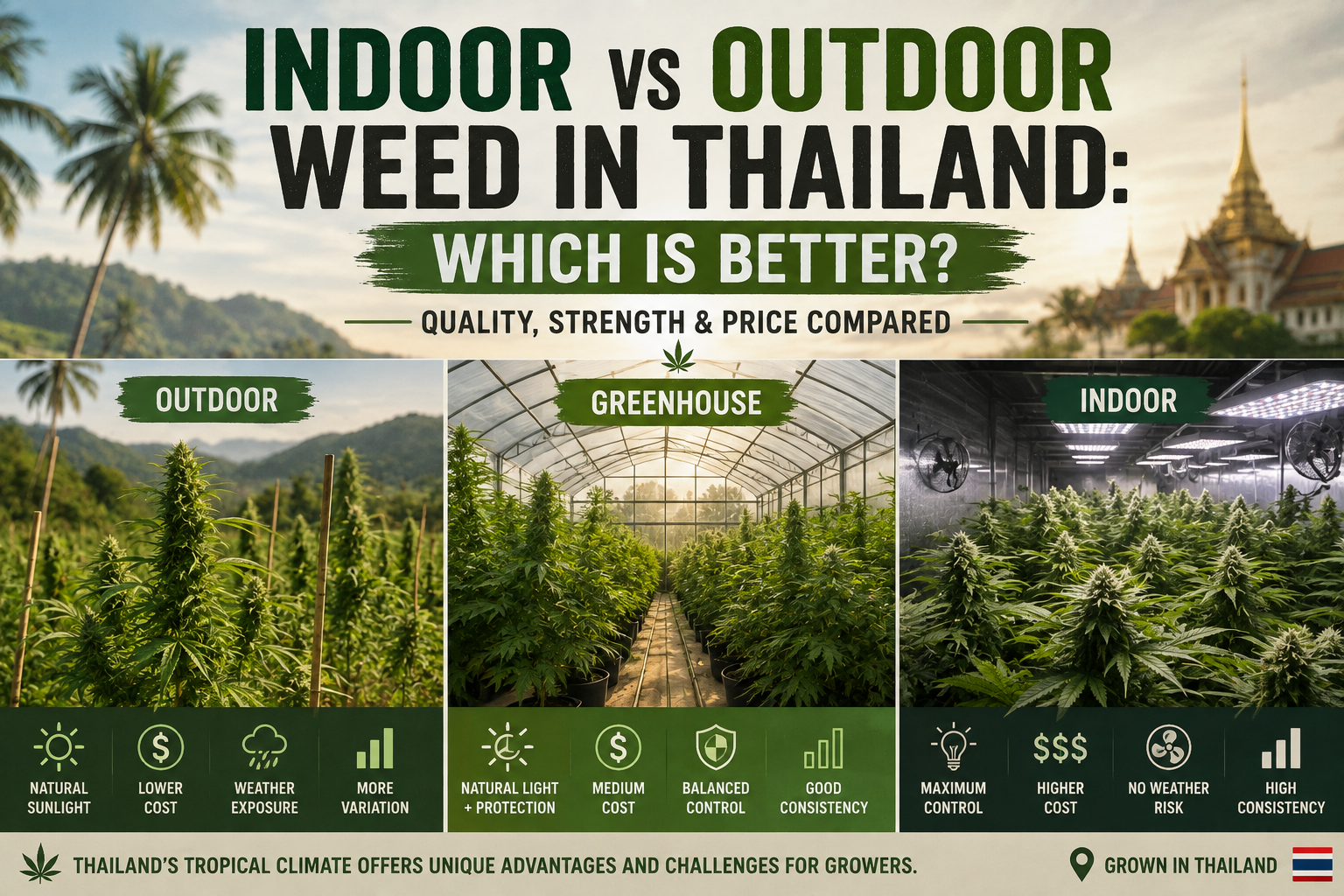
Indoor vs Outdoor Weed in Thailand is more complicated than simply saying indoor is premium and outdoor is cheap. Thailand has something many cannabis-producing countries would love to have: intense tropical sunlight and a climate capable of supporting vigorous plant growth. At the same time, that tropical environment brings heat, high humidity, heavy rain, pests, and mold pressure that can make consistent cannabis cultivation challenging.
This creates an interesting question for Thai cannabis buyers: does Thailand’s tropical climate make outdoor cannabis better value, or do the heat and humidity actually give indoor growers an advantage? The answer depends on what matters most to you. Indoor cannabis can offer greater environmental control and consistency, while properly grown outdoor flower can take advantage of Thailand’s natural conditions at a much lower production cost. Greenhouse cultivation sits somewhere between the two.
This guide compares Thai indoor, outdoor, and greenhouse cannabis by quality, price, consistency, strength, appearance, and value. WeedBKK categorizes products and provides THC/CBD information where available so customers can compare what they are actually buying rather than assuming the most expensive indoor flower must always be best.
Important: Thailand’s cannabis market is currently medical-focused, and cannabis flower is a controlled herb. Visitors should follow current Thai medical and prescription requirements. This article explains cultivation methods and product quality for educational purposes.
Contents:
- Indoor vs Outdoor Weed in Thailand: Which Is Actually Better?
- What Makes Growing Cannabis in Thailand Different?
- Thai Indoor Weed: Why Does It Usually Cost More?
- Thai Outdoor Weed: Cheap Doesn’t Automatically Mean Bad
- Greenhouse Weed in Thailand: The Best of Both Worlds?
- Indoor vs Outdoor vs Greenhouse: Price, Strength and Quality Compared
- Which Thai Weed Should You Choose: Indoor, Greenhouse or Outdoor?
Indoor vs Outdoor Weed in Thailand: Which Is Actually Better?
Indoor weed is often presented as the premium choice in Thailand. Walk into a dispensary and you may see terms such as “premium indoor,” “exotic indoor,” and “top shelf” attached to some of the highest prices on the menu. Outdoor cannabis, meanwhile, is frequently placed in the budget category. That can create the impression that indoor automatically means good and outdoor automatically means inferior.
That is too simplistic. The cultivation environment matters, but so do genetics, grower skill, plant health, harvest timing, drying, curing, trimming, storage, and freshness. Excellent outdoor cannabis can be better than poorly grown or badly stored indoor cannabis. Likewise, a skilled indoor grower can produce extremely consistent flower that would be difficult to achieve outdoors.
The difference is primarily about control. Indoor growers can manage lighting, temperature, humidity, airflow, and other environmental conditions. Outdoor growers give up much of that control in exchange for natural sunlight and significantly lower infrastructure costs. Greenhouses attempt to combine advantages from both systems.
This is especially important in Thailand because the country’s climate amplifies both the advantages and disadvantages of outdoor cultivation. Thailand has abundant sunlight, but growers must also contend with tropical heat, humidity, and seasonal rain.
Key takeaway: indoor is not automatically better and outdoor is not automatically bad. The cultivation method tells you how the cannabis was grown, not whether the grower did a good job.
What Makes Growing Cannabis in Thailand Different?
Thailand’s tropical climate is one of the biggest reasons this comparison differs from an indoor-versus-outdoor discussion written for Europe or North America. Cannabis grown outdoors in Thailand can receive abundant natural sunlight and relatively long periods of suitable growing conditions. Thailand also has a long historical association with cannabis cultivation and traditional Thai genetics.
Natural sunlight is effectively free, which gives outdoor growers a major economic advantage. Indoor growers need equipment to reproduce and control conditions that nature provides outside. That can include powerful lighting, ventilation, cooling, dehumidification, irrigation systems, and environmental monitoring.
But Thailand’s climate also creates problems. High humidity can increase mold and fungal pressure, particularly when dense flowers remain damp. Heavy seasonal rain can damage crops or make moisture control difficult. Heat can stress plants, while tropical conditions can support insects and other pests.
The challenge continues after harvest. Drying and curing cannabis correctly in a humid environment requires care. A good crop can lose considerable quality through poor post-harvest handling. Cannabis stored badly in Thailand’s heat and humidity can also deteriorate faster or potentially develop moisture-related problems.
This means Thailand has excellent natural growing potential but also rewards growers who understand tropical cultivation. The country’s climate is neither automatically good nor bad for cannabis—it simply creates a different set of advantages and challenges.
Key takeaway: Thailand offers excellent sunlight and growing potential, but humidity, rain, heat, pests, drying, and storage make consistency more difficult outdoors.
Thai Indoor Weed: Why Does It Usually Cost More?
Thai indoor weed usually costs more because creating a controlled growing environment is expensive. Instead of relying primarily on sunlight and natural weather, indoor growers use equipment to create the conditions they want throughout the cultivation cycle.
Lighting is one cost, but Thailand adds another important expense: climate control. Powerful grow lights and equipment generate heat, while the outside environment can already be hot and humid. Maintaining appropriate temperature and humidity may require air conditioning, ventilation, airflow management, and dehumidification.
That investment provides an important advantage: consistency. Indoor growers can reduce exposure to heavy rain and many outdoor environmental fluctuations. They can control light schedules and adjust environmental conditions according to different stages of plant development. Skilled growers can therefore reproduce similar conditions from one crop to another.
Indoor flower may consequently appear more uniform, with dense flowers and carefully controlled finishing. But appearance still should not be confused with overall quality. Indoor cannabis can be harvested badly, dried badly, stored badly, or simply come from mediocre genetics.
This also explains why genuinely cheap “premium indoor” deserves questions. Indoor cultivation has real production costs. A legitimate promotion is possible, but extremely cheap flower simultaneously advertised as fresh, high-THC, top-quality indoor cannabis should encourage buyers to ask what they are actually getting.
For more examples of misleading product claims, see Weed Scams Thailand.
Key takeaway: Thai indoor weed usually costs more because growers are paying for environmental control and consistency—not simply because the word “indoor” makes cannabis premium.
Thai Outdoor Weed: Cheap Doesn’t Automatically Mean Bad
Outdoor cannabis has an image problem in parts of Thailand’s modern dispensary market. Because it is often cheaper, some buyers assume it must be weak or poor quality. That is not necessarily true. Outdoor cannabis has one enormous advantage: the sun.
Thailand receives strong natural sunlight, and outdoor growers do not need to reproduce that energy with expensive indoor lighting. Infrastructure and electricity requirements can therefore be considerably lower. Those savings can allow outdoor flower to reach customers at lower prices without automatically meaning something is wrong with it.
Outdoor cultivation does, however, produce greater variability. Plants experience changes in temperature, humidity, rain, wind, insects, and other environmental conditions. Appearance may be less uniform than carefully controlled indoor flower, and poor growers can struggle with mold, pests, contamination, or inconsistent harvests.
Post-harvest handling becomes especially important. Well-grown outdoor cannabis that is properly dried, cured, and stored can offer excellent value. The same crop handled carelessly in Thailand’s humidity may become disappointing very quickly. Buyers should therefore care about freshness and storage just as much as the word “outdoor.”
This connects directly with Thailand’s budget cannabis market. Cheap weed does not automatically mean fake or dangerous. There are legitimate reasons outdoor flower can cost less. The warning sign is when a seller cannot explain where the low price comes from or falsely presents budget flower as something much more expensive.
For more on legitimate ways cannabis prices can differ, read How to Get Cheap Weed in Thailand: Legal Ways to Save Money.
Key takeaway: good Thai outdoor weed can provide excellent value because sunlight lowers production costs. Cheap outdoor cannabis and suspiciously cheap “premium indoor” cannabis are not the same thing.
Greenhouse Weed in Thailand: The Best of Both Worlds?
Greenhouse cannabis is particularly interesting in Thailand because it attempts to combine natural sunlight with greater environmental protection. Instead of placing plants completely outdoors or completely under artificial indoor lighting, greenhouse growers use a structure that allows sunlight to reach the crop while providing additional control.
This can be a strong fit for Thailand. Growers can take advantage of abundant tropical sunlight while reducing direct exposure to heavy rain and some environmental problems. Depending on the greenhouse, growers may also use ventilation, supplemental lighting, humidity management, irrigation, shading, or other controls.
The result can be a useful middle ground. Greenhouse production usually does not require the same level of artificial lighting and environmental infrastructure as fully indoor cultivation, potentially reducing costs. At the same time, growers gain more control than they would have in an exposed outdoor field.
That does not make every greenhouse product superior. A basic greenhouse and a highly controlled modern greenhouse can be very different operations. Grower skill, genetics, drying, curing, and storage still determine whether the finished product is actually good.
For Thai consumers interested in price-to-quality rather than simply buying the most expensive option, good greenhouse flower can therefore be one of the most interesting categories on a menu.
Key takeaway: greenhouse cannabis can make particular sense in Thailand because growers can use the country’s strong natural sunlight while gaining more protection and control than fully outdoor cultivation.
Indoor vs Outdoor vs Greenhouse: Price, Strength and Quality Compared
Comparing indoor, outdoor, and greenhouse weed becomes easier when the categories are treated as cultivation methods rather than quality grades. Each method has advantages and disadvantages, and each can produce good or bad cannabis.
| Factor | Indoor | Greenhouse | Outdoor |
|---|---|---|---|
| Environmental control | Highest | Medium to High | Lowest |
| Natural sunlight | Limited / No | Yes | Yes |
| Weather exposure | Minimal | Reduced | Highest |
| Production cost | Highest | Medium | Lowest |
| Consistency | Usually Highest | Often Good | More Variable |
| Typical price | $$$ | $$ | $ |
| Automatically better? | No | No | No |
Strength deserves special attention. Indoor cannabis is often associated with higher THC because growers can optimize conditions and high-potency genetics are common in premium indoor markets. But cultivation method alone does not determine THC content. Outdoor and greenhouse plants can also produce potent flower.
More importantly, THC is not a complete quality score. A fresh, aromatic, properly cured greenhouse strain at 18% THC can potentially be a better product for a particular person than old indoor flower advertised at 28%. Terpenes, CBD, genetics, freshness, tolerance, and overall cultivation quality matter too.
If THC percentages such as 10%, 20%, and 30% are confusing, read our Thai Weed Strength guide. It explains why the biggest percentage on a menu is not automatically the best choice.
Key takeaway: indoor generally offers maximum control, outdoor offers the lowest production costs, and greenhouse sits between them. None of those categories guarantees quality or potency.
Which Thai Weed Should You Choose: Indoor, Greenhouse or Outdoor?
The best choice depends on what you value. Someone prioritizing consistency may prefer properly grown indoor cannabis. Someone interested in balancing quality and price may find greenhouse flower more attractive. Someone looking for budget-friendly cannabis may discover that well-grown Thai outdoor flower offers better value than expected.
Do not pay for terminology alone. “Premium indoor” should describe something meaningful about the cultivation and finished product, not simply justify a higher price. Similarly, “outdoor” should not automatically be treated as an inferior category. Ask about freshness, storage, cultivation, THC/CBD information where available, and why one product costs more than another.
Beginners should also resist choosing solely according to potency. A high-THC indoor strain may cost considerably more and still be less appropriate than a moderate greenhouse or outdoor product. If you are unfamiliar with potency, see Thai Weed Strength and First Time Buying Weed in Thailand.
WeedBKK’s role is to make those comparisons easier by providing product categories and THC/CBD information where available. A useful cannabis menu should help customers understand the differences between products instead of simply arranging them from cheapest to most expensive.
The final takeaway is simple: Thailand’s tropical climate makes outdoor cannabis potentially excellent value, while the same heat and humidity make indoor environmental control genuinely valuable. Greenhouse cultivation can offer an attractive compromise between the two. The best Thai weed is therefore not automatically indoor, outdoor, or greenhouse—it is the product that has been grown, harvested, cured, stored, and described properly for its intended medical use.