
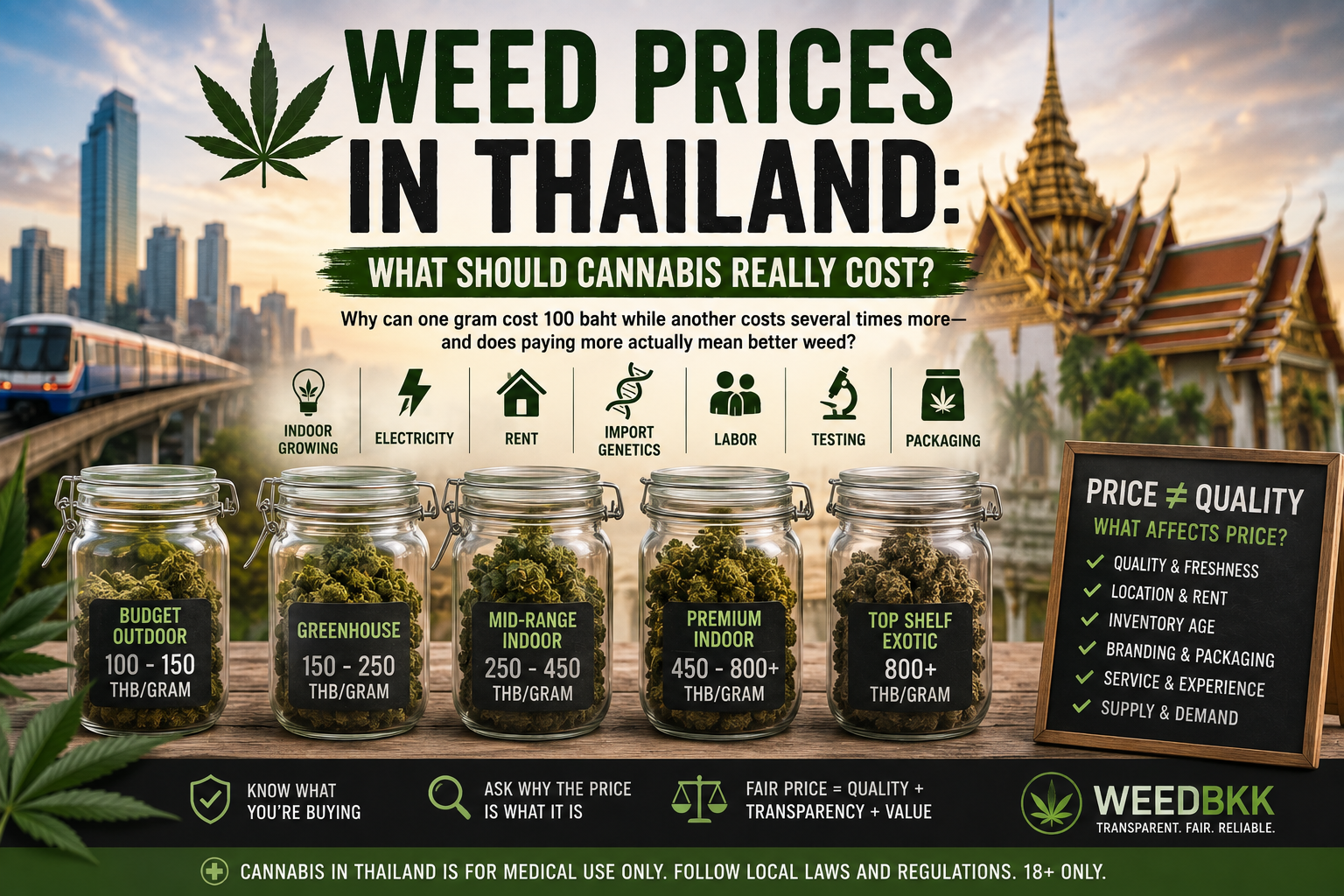
Weed prices in Thailand can be confusing. One dispensary may advertise cannabis for around 100 baht per gram while another asks several times that amount for flower described as indoor, exotic, premium, or top shelf. For tourists and first-time buyers, the obvious question is: does paying more actually mean you’re getting better weed?
Not necessarily. Cannabis prices can reflect genuine differences in cultivation, genetics, freshness, testing, storage, and quality. But price can also reflect electricity, labor, packaging, rent, branding, excess inventory, promotions, service, and simply how much customers in a particular neighborhood are willing to pay. A gram sold from an expensive storefront in central Bangkok has different business costs from the same type of product sold by a smaller operation outside the main tourist areas.
This guide explains what goes into cannabis pricing in Thailand, why genuinely cheap weed exists, why premium flower can become expensive, and how buyers can judge whether a price seems reasonable. WeedBKK does not aim to be Thailand’s absolute cheapest option; the focus is on transparent product information, fair pricing, and helping customers understand what they are paying for.
Important: Thailand’s cannabis market is currently medical-focused and cannabis flower is a controlled herb. Visitors should follow current Thai medical and prescription requirements. Prices and examples in this article are educational and should not be interpreted as encouragement to purchase cannabis outside legal medical channels.
Contents:
- Weed Prices in Thailand: How Much Should You Expect to Pay?
- What Actually Goes Into the Price of Weed in Thailand?
- Why Is Some Weed in Thailand So Cheap?
- Why Does Premium Weed Cost So Much?
- Are Weed Prices Higher in Bangkok and Tourist Areas?
- Cheap vs Expensive Weed: How Do You Know If the Price Is Fair?
- What Is a Fair Weed Price in Thailand?
Weed Prices in Thailand: How Much Should You Expect to Pay?
There is no single normal weed price in Thailand. The market includes inexpensive outdoor flower, greenhouse products, locally produced indoor cannabis, premium small-batch flower, and heavily branded products sold from expensive tourist-facing dispensaries. Comparing all of them using one price per gram is like asking what a normal bottle of wine should cost—the category alone does not tell the whole story.
At the budget end, customers may encounter flower around 100 baht per gram or sometimes less during promotions, clearance sales, or larger-quantity offers. Mid-range products can cost several hundred baht per gram, while premium dispensaries may charge considerably more for selected indoor strains. These are broad market examples rather than fixed price rules, because promotions, quality, location, and supply can change prices quickly.
The important mistake to avoid is assuming that the price itself proves quality. A 100-baht gram is not automatically bad, and a 500-baht gram is not automatically five times better. The cheaper product may be locally grown outdoor flower with low production costs, while the expensive product may genuinely involve sophisticated indoor cultivation—or simply be sold from a costly storefront in a tourist district.
This is why buyers should understand the product category before comparing prices. Outdoor, greenhouse, and indoor cannabis have very different production economics. Read Indoor vs Outdoor Weed in Thailand for a deeper comparison.
Key takeaway: Thailand does not have one correct price per gram. Price only becomes meaningful when you understand what kind of cannabis you are comparing.
What Actually Goes Into the Price of Weed in Thailand?
Growing cannabis costs money long before it reaches a dispensary shelf. Genetics or plant material must be obtained, plants must be cultivated, harvested, dried, cured, trimmed, stored, packaged, transported, and eventually sold. Labor is involved throughout that process.
Indoor cannabis adds significant infrastructure. Growers may need powerful lighting, air conditioning, ventilation, dehumidification, irrigation, monitoring equipment, and controlled growing rooms. Thailand creates a particular challenge because the outside environment is naturally hot and humid. Maintaining tightly controlled indoor conditions can therefore require substantial climate management and electricity.
Outdoor growers have a major advantage: Thailand provides abundant natural sunlight. That can dramatically reduce lighting and infrastructure costs. Greenhouses sit between the two systems, using sunlight while providing greater environmental protection and control than completely exposed outdoor cultivation.
The costs do not stop after harvest. Proper drying and curing are important, particularly in Thailand’s humid climate. Storage, humidity control, packaging, product handling, testing where applicable, staff, transportation, and business compliance can all contribute to the final retail price.
Then comes the dispensary itself. Rent, salaries, electricity, payment processing, customer service, extended opening hours, delivery infrastructure, website maintenance, packaging, and marketing all have to be funded somehow. Ultimately, those costs are reflected in retail prices.
Key takeaway: when you pay for cannabis, you are not only paying for the plant. You are paying for cultivation, post-harvest handling, business overhead, location, and service as well.
Why Is Some Weed in Thailand So Cheap?
Cheap weed does not automatically mean fake weed. There are several completely legitimate reasons why a dispensary might sell cannabis significantly below another shop’s prices. Understanding those reasons helps buyers separate genuine value from suspicious offers.
Outdoor cultivation is one of the simplest explanations. Thai growers can use natural sunlight instead of paying for artificial lighting and intensive climate control. A competent outdoor grower can therefore produce flower for substantially less than a sophisticated indoor operation.
Excess inventory is another reason. Cannabis businesses sometimes have more stock than they can sell quickly. A store may reduce prices to move inventory and free space for newer products. Market oversupply can also push prices down across multiple businesses.
Clearance and ageing stock can produce especially large discounts. Cannabis does not stay at peak freshness forever. Aromatic compounds can deteriorate and flower can become dry or otherwise decline when stored for long periods. A responsible business may therefore prefer to sell older stock at a discount rather than continue asking the original premium price.
Promotions, larger purchases, membership discounts, lower rent, simpler packaging, local production, and reduced marketing expenses can also explain lower prices. A shop outside an expensive tourist district may simply need less revenue from every sale to cover its overhead.
What matters is whether the explanation makes sense. “Locally grown outdoor flower on clearance” provides a logical reason for a low price. “Fresh imported exotic premium indoor 30% THC” offered at an unbelievably low price deserves more questions.
For legitimate money-saving strategies, read How to Get Cheap Weed in Thailand: Legal Ways to Save Money. For situations where cheap becomes suspicious, see Cheap Weed Thailand and Weed Scams Thailand.
Key takeaway: cheap cannabis can be perfectly legitimate. The important question isn’t simply “Why is this cheap?” but whether the seller can give a believable answer.
Why Does Premium Weed Cost So Much?
Premium cannabis pricing is easier to understand when you separate the product premium from the establishment premium. They are not the same thing, even though both appear in the final price.
A genuine product premium may come from carefully controlled indoor cultivation, selected genetics, skilled growers, smaller batches, extensive environmental control, careful trimming, proper curing, storage, testing, and greater consistency. These things require time, equipment, expertise, and money.
But customers may also be paying an establishment premium. A beautiful dispensary on Sukhumvit or close to a major Pattaya nightlife area can have expensive rent. Air conditioning, interior design, multilingual staff, late opening hours, marketing, premium packaging, convenient payment options, and customer support all increase operating costs.
That distinction matters because an expensive gram is not necessarily expensive entirely because of the cannabis itself. Part of the price may be paying for convenience, location, presentation, and service. There is nothing inherently wrong with that—customers routinely pay more for coffee, cocktails, restaurants, and hotels in premium locations—but they should understand what they are purchasing.
Branding can add another premium. Attractive packaging and words such as “exotic,” “Cali,” “craft,” or “top shelf” can influence perception. Those descriptions should be supported by actual product quality rather than functioning solely as justification for a higher price.
Key takeaway: premium pricing can reflect genuinely better cultivation and handling, but it can also reflect the cost of the business selling it. Expensive does not automatically mean proportionally better.
Are Weed Prices Higher in Bangkok and Tourist Areas?
Weed prices can be higher in heavily visited areas, but saying “Bangkok is expensive” is too simplistic. Bangkok contains everything from luxury shopping districts and international nightlife areas to residential neighborhoods and local commercial streets. Cannabis pricing can vary accordingly.
Areas around Sukhumvit, Asok, Nana, and other heavily visited locations can support premium pricing because commercial rent is expensive and there is constant tourist traffic. International visitors may also prioritize convenience over price comparison, especially when they are staying only a few days.
Move away from the highest-rent tourist corridors and the economics change. Smaller businesses serving more local or repeat customers may have lower overhead and stronger pressure to remain price competitive. This does not guarantee cheaper or better cannabis, but it can make normal local-market pricing easier to find.
The same principle applies in Pattaya. A highly visible business near Walking Street or Beach Road operates in a different commercial environment from one serving customers in Jomtien, Naklua, or more residential areas. Tourist-location premiums exist across restaurants, bars, accommodation, and retail—not only cannabis.
However, traveling across a city just to save a small amount does not always make financial sense. Transport costs and time matter too. A slightly more expensive nearby option with clear information and reliable service can represent better overall value than spending money and an hour traveling for a minor discount.
For local price comparisons, see Where to Find Cheap Weed in Bangkok and Where to Find Cheap Weed in Pattaya.
Key takeaway: tourist areas can carry higher cannabis prices, but both Bangkok and Pattaya have much broader markets once you move beyond their most expensive commercial streets.
Cheap vs Expensive Weed: How Do You Know If the Price Is Fair?
The best way to judge cannabis pricing is to stop asking only “How much does it cost?” and start asking “Why does it cost this much?” A seller who can explain the answer gives you considerably more useful information.
| Why the Price Changes | Usually Cheaper | Usually More Expensive |
|---|---|---|
| Cultivation | Outdoor | Controlled indoor |
| Location | Residential / local | Tourist / nightlife |
| Inventory | Clearance / older batch | Fresh / new batch |
| Quantity | Larger quantities | Single gram |
| Branding | Basic presentation | Premium branding |
| Store overhead | Smaller / lower rent | Premium storefront |
| Service | Basic | Extended hours / support |
| Quality control | Can vary | Testing and documentation can add cost |
Imagine one product costs around 100–150 baht per gram and the seller openly describes it as locally grown outdoor flower from an older batch being discounted. The price has a logical explanation. It may not be premium flower, but it could still represent fair value.
Now imagine another product at roughly the same price being described as fresh, premium indoor, imported exotic genetics, extremely high THC, and top shelf. Those claims involve production characteristics normally associated with higher costs. The mismatch between price and story should encourage further questions.
The same reasoning works in reverse. A 500- or 600-baht product may be genuinely exceptional indoor flower with good handling and documentation. But ordinary flower does not automatically become premium because it sits inside a beautiful dispensary with expensive furniture.
THC percentages can also distort perceived value. Some customers will pay substantially more for 30% THC than 20% even though THC is not a complete measure of quality. Read Thai Weed Strength before paying a large premium solely for potency claims.
Key takeaway: fair pricing has an explanation. The cultivation method, condition, quality, location, and service should make sense relative to what you are being charged.
What Is a Fair Weed Price in Thailand?
There is no single correct weed price in Thailand. The market is too varied for one number to represent outdoor, greenhouse, indoor, budget, premium, local, and tourist-area cannabis at the same time. A realistic buyer should therefore think in categories rather than search for one universal “normal price.”
A fair price is one where quality, cultivation method, freshness, product information, location, and service reasonably explain what you are paying. Cheap cannabis can be excellent value when there is a legitimate reason for the low price. Expensive cannabis can also be worthwhile when the quality and service genuinely justify the premium.
The extremes deserve the most scrutiny. Dirt-cheap cannabis accompanied by extraordinary premium claims should raise questions. Extremely expensive cannabis accompanied by very little product information should do the same. Transparency matters at both ends of the market.
WeedBKK’s position is not that the cheapest cannabis is automatically the best deal. The goal is fair and transparent value: customers should understand the product category, THC and CBD information where available, price, and relevant service costs rather than discovering unexplained differences after making a decision.
If you are new to the market, read First Time Buying Weed in Thailand and How to Read a Cannabis Menu in Thailand. If your priority is saving money, continue with How to Get Cheap Weed in Thailand: Legal Ways to Save Money.
The final takeaway is simple: a 100-baht gram isn’t automatically a bargain, and a 500-baht gram isn’t automatically premium. Understand why the price is different. In Thailand, cultivation costs, electricity, climate control, inventory age, location, rent, branding, service, and tourist demand can all change the final number—sometimes just as much as the cannabis itself.