
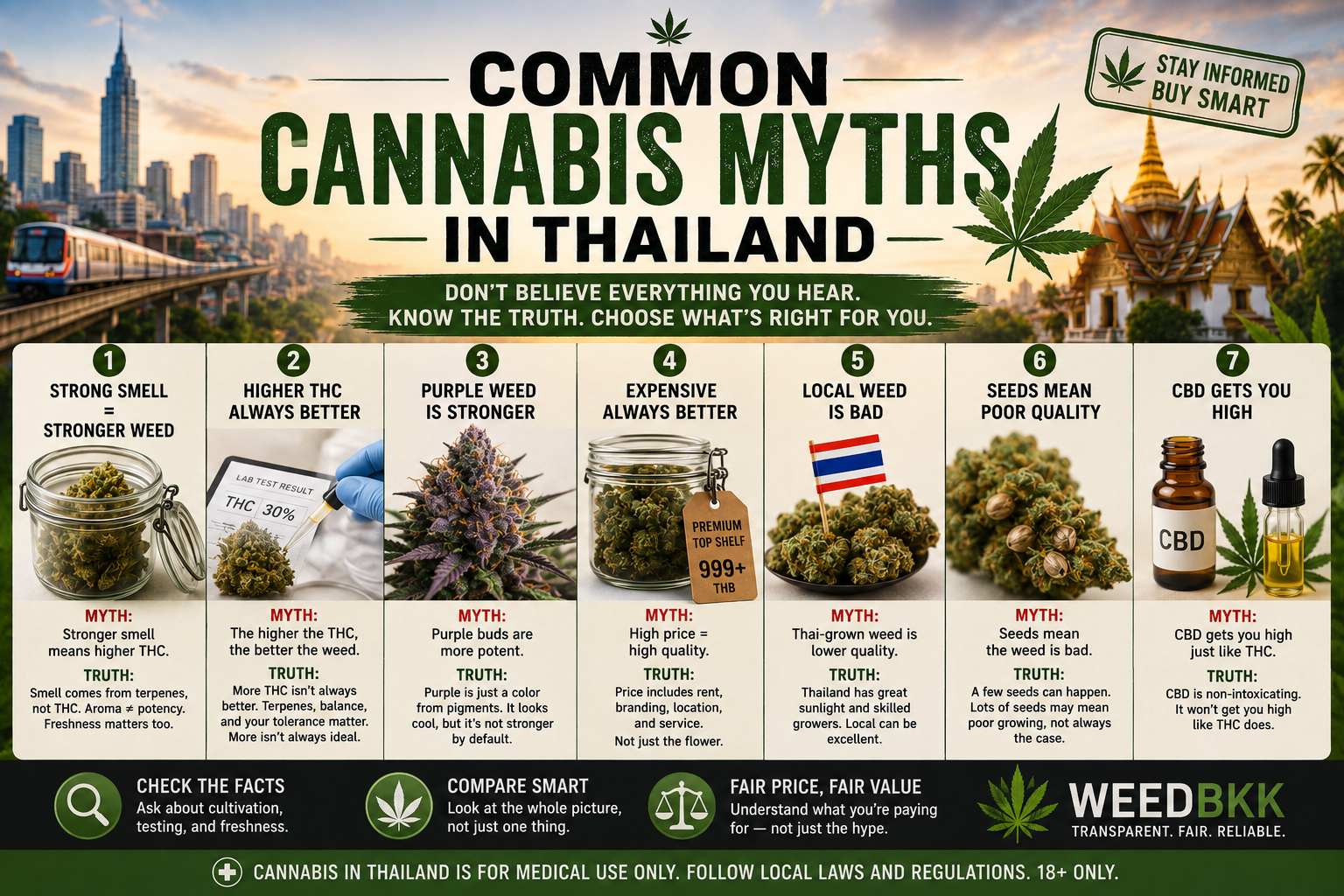
Common Cannabis Myths in Thailand can make an already confusing market even harder to understand. Walk through a cannabis shop in Bangkok or Pattaya and you may hear that the strongest-smelling flower must have the most THC, purple buds are automatically premium, imported genetics are better than Thai-grown cannabis, or that the most expensive jar must contain the best product.
Many of these ideas contain a small piece of truth that has been exaggerated into a rule. Thailand makes the subject particularly interesting because its cannabis market combines traditional Thai genetics, modern indoor cultivation, tropical outdoor growing, greenhouse production, international genetics, tourist-focused dispensaries, and enormous differences in price.
This guide looks at seven common cannabis myths from a Thai perspective and explains what buyers should actually pay attention to. WeedBKK encourages customers to compare real product information rather than relying on THC hype, appearance, price, or fashionable strain names.
Important: Thailand’s cannabis market is currently medical-focused and cannabis flower is a controlled herb. Visitors should follow current Thai medical and prescription requirements. This article is educational and focuses on understanding cannabis products and marketing claims.
Contents:
- Myth 1: Strong-Smelling Weed Is Always Stronger
- Myth 2: Higher THC Always Means Better Weed
- Myth 3: Purple Weed Is Stronger and More Premium
- Myth 4: Expensive Weed Is Always Better
- Myth 5: Local Thai Weed Is Lower Quality
- Myth 6: Finding Seeds Means the Weed Is Bad
- Myth 7: CBD Gets You High Just Like THC
Myth 1: Strong-Smelling Weed Is Always Stronger
A powerful smell does not automatically mean cannabis contains more THC. Cannabis aroma primarily comes from volatile compounds including terpenes. Depending on the genetics, flower may smell citrusy, fruity, floral, earthy, spicy, herbal, or particularly pungent without that aroma directly telling you its THC percentage.
This myth is especially relevant in Thailand because heat and storage conditions can affect aroma. Fresh flower that has been dried, cured, and stored properly may preserve its terpene profile much better than cannabis that has spent too long exposed to heat, air, or poor humidity control. A strong and pleasant aroma can therefore tell you something about the character and condition of a product without functioning as a THC test.
The opposite can also happen. High-THC flower that has been stored badly may lose much of its aroma. That does not necessarily mean all of its cannabinoids suddenly disappeared. Likewise, extremely pungent cannabis is not guaranteed to be exceptionally potent.
Smell is still useful. Aroma can help buyers notice freshness, terpene characteristics, and potentially obvious storage problems. It simply should not be interpreted as a potency meter.
Takeaway: strong smell can indicate an aromatic, terpene-rich product, but your nose cannot reliably tell you the THC percentage.
Myth 2: Higher THC Always Means Better Weed
Higher THC means more THC concentration, not automatically better cannabis. This is one of the most important myths for Thai buyers because dispensary menus often place significant emphasis on percentages such as 20%, 25%, and 30% THC.
That makes comparison seem easy. If one strain says 18% and another says 30%, surely 30% must be the premium choice? Not necessarily. Cannabis quality also involves genetics, cultivation, freshness, curing, storage, terpenes, cannabinoid composition, and whether the product is appropriate for the individual using it.
For inexperienced users, very high THC can actually be a disadvantage. More THC can increase the likelihood of unwanted intoxication, anxiety, dizziness, or an uncomfortable experience. Someone using cannabis under medical guidance may not need—or benefit from—the strongest flower available.
There is also the question of how reliable the percentage is. Testing can vary, plants naturally vary, and not every number appearing on a dispensary menu should be treated as unquestionable laboratory truth.
For a deeper comparison of 10%, 20%, and 30% flower, see Thai Weed Strength.
Takeaway: THC measures one important part of potency. It is not a score out of 100 for overall cannabis quality.
Myth 3: Purple Weed Is Stronger and More Premium
Purple cannabis looks impressive, but purple color does not prove high potency. The colors seen in cannabis can be influenced by genetics, pigments called anthocyanins, growing conditions, temperature, and plant development.
This matters in a visually driven dispensary market. Attractive purple flower photographs extremely well and can look exotic inside a glass jar. That makes it easy to market as premium cannabis, especially to inexperienced tourists who associate unusual color with strength.
A purple strain can absolutely be excellent cannabis. It can also be average cannabis with attractive coloration. Likewise, ordinary green flower can be exceptionally well grown and potent. The color by itself tells you very little about THC content.
Buyers should therefore compare the same things they would with any other flower: product information, genetics where known, freshness, aroma, cultivation method, condition, and reliable cannabinoid information where available.
Takeaway: purple is a characteristic, not a quality grade. Enjoy the appearance, but do not automatically pay a premium just because the flower is colorful.
Myth 4: Expensive Weed Is Always Better
Price and quality are related sometimes—but certainly not always. This misconception becomes particularly important in Bangkok and Pattaya because cannabis prices can change dramatically between neighborhoods.
Genuine premium cannabis can cost more for understandable reasons. Controlled indoor cultivation requires equipment, electricity, cooling, humidity management, skilled labor, careful drying and curing, storage, and potentially testing. Better production can legitimately increase the price.
But the customer may also be paying for something completely separate from flower quality: expensive rent. A stylish dispensary around a major Bangkok tourist district or Pattaya nightlife area can have considerably higher operating costs than a smaller shop in a residential neighborhood.
Premium packaging, interior design, extended opening hours, multilingual staff, advertising, delivery support, and convenience can also appear in the final retail price. None of those things are inherently bad, but they do not increase the THC or improve the flower inside the package.
This is why WeedBKK’s approach is based on fair value rather than claiming the cheapest price must be best. If you want to understand these differences in detail, read Weed Prices in Thailand: What Should Cannabis Really Cost?.
Takeaway: expensive cannabis can be excellent, but a high price can represent the product, the location, the service—or a combination of all three.
Myth 5: Local Thai Weed Is Lower Quality
Thai-grown does not mean low quality. This idea partly comes from comparing traditional outdoor cannabis with the highly manicured indoor flower associated with modern North American cannabis markets. They can look very different, but appearance and country of origin are not complete measures of quality.
Thailand has an important natural advantage: abundant tropical sunlight and a long history of cannabis cultivation. Modern Thai growers also use indoor rooms, sophisticated greenhouses, imported or international genetics, controlled irrigation, and contemporary cultivation techniques. “Local” can therefore describe everything from inexpensive outdoor flower to carefully controlled premium indoor crops.
Thailand’s climate does create challenges. Humidity, rain, heat, pests, drying, curing, and storage all require attention. Poorly handled outdoor flower can suffer considerably in these conditions. But those challenges do not mean Thai-grown cannabis is inherently inferior.
Imported genetics also do not make cannabis foreign-grown. A Thai cultivator can grow internationally developed genetics inside Thailand, just as growers elsewhere use genetics originating from many different regions. Genetics and cultivation location are two different questions.
Our Indoor vs Outdoor Weed in Thailand guide explains why Thailand’s climate can be both an advantage and a challenge.
Takeaway: judge Thai cannabis by how it was grown, harvested, cured, stored, and documented—not simply by whether it was grown locally.
Myth 6: Finding Seeds Means the Weed Is Bad
A seed does not automatically make cannabis unusable or poor quality. Cannabis plants can produce seeds when pollination occurs, and occasional seeds can appear even in otherwise reasonable flower. However, lots of seeds can tell you something about how the crop was produced.
Modern premium flower is generally cultivated with the intention of preventing significant seed production. A heavily seeded batch may therefore indicate pollination or cultivation conditions that differ from what customers expect from expensive premium flower.
The important factor is context. Finding one unexpected seed in budget outdoor cannabis is very different from paying a substantial premium for supposedly flawless top-shelf indoor flower and discovering that the entire batch is heavily seeded.
Seeds can therefore influence value without functioning as a simple good-or-bad test. The more premium the seller’s claims and price, the more reasonable it is for customers to expect consistency in the finished product.
Takeaway: one seed does not prove cannabis is bad, but heavily seeded flower may indicate cultivation issues and should be considered when judging whether the price is fair.
Myth 7: CBD Gets You High Just Like THC
CBD does not produce the same intoxicating high associated with THC. THC and CBD are both cannabinoids found in cannabis, but they interact with the body differently. Confusing the two can make cannabis menus particularly difficult for beginners.
A product containing CBD is therefore not simply a weaker version of a high-THC product. CBD-rich and THC-rich products can have very different purposes and effects, and the appropriate cannabinoid profile depends on the individual and the medical guidance involved.
This distinction matters in Thailand’s current medical-focused cannabis environment. Buyers should understand what cannabinoids a product actually contains rather than assuming all cannabis products are intended to produce intoxication.
WeedBKK lists THC and CBD information where available because those numbers answer different questions. A customer looking only at THC may overlook information that is more relevant to their needs.
Takeaway: CBD and THC are not interchangeable. CBD is not known for producing the characteristic intoxicating high caused by THC.
The bigger lesson behind these common cannabis myths in Thailand is simple: cannabis cannot be judged by one characteristic. Smell does not prove potency. THC does not prove quality. Purple does not mean stronger. Expensive does not guarantee better. Thai-grown does not mean inferior. One seed does not ruin a product, and CBD is not simply another name for THC.
The more useful approach is to look at the complete product: cultivation method, genetics, freshness, curing, storage, cannabinoid information, price, and whether the seller can clearly explain what you are getting. That is particularly important in Thailand, where outdoor, greenhouse, indoor, local, international, budget, and premium cannabis can all appear on the same menu.